Every morning, I check the condition of the Cosmos flowers and divide each of them into the best vases/pots.
I hope them to keep their lives as long as possible!

Every morning, I check the condition of the Cosmos flowers and divide each of them into the best vases/pots.
I hope them to keep their lives as long as possible!

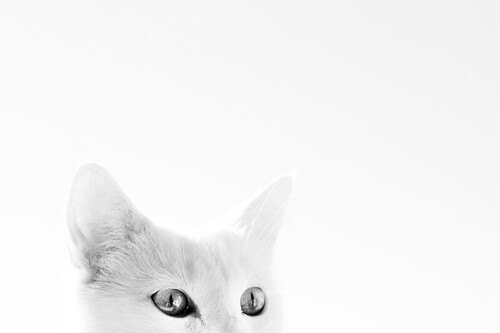
I was about to take a minimal picture of a white wall but my cat had other ideas and stuck it´s head in the frame so I ended up with a out of frame, minimal cat portrait :)
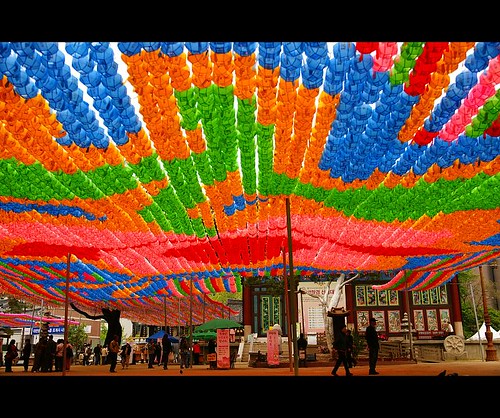
It was such a good timing during our visit since it fell on the time the Lotus lantern Festival also took place! Here you can see these colorful lanterns hanging around the Yeondeung Buddhist Temple!
---- .... ---- ....
Buddha's Birthday (simplified Chinese: 佛诞; traditional Chinese: 佛誕; pinyin: fó dàn; Cantonese: fātdáan), the birthday of the Prince Siddhartha Gautama traditionally celebrated in East Asia on the eighth day of the fourth month in the Chinese lunar calendar, is an official holiday in Hong Kong, Macau, and South Korea. The date varies from year to year in the Western (Gregorian) calendar:
The birth of the Buddha is often celebrated by Buddhists in India for an entire month in the Buddhist calendar. The actual day is called Buddha Poornima (or Buddha Purnima), also traditionally known as Vaishakh Poornima. Although the day marks not just the birth of Shakyamuni Gautam Buddha, but also the day of Enlightenment, and Mahaparinirvana. But as a gentle effect of West, the event of Birth is given paramount importance. The event is celebrated by gentle and serene fervour, keeping in mind the very nature of Buddhism. People, especially women, go to common Viharas to observe a rather longer-than-usual, full-length Buddhist sutra, as something like a service. The usual dress is pure white. Non-vegetarian food is normally avoided. Kheer, a sweet rice porridge is commonly served to recall the story of Sujata, a maiden who, in Gautama Buddha's life, offered the Buddha a bowl of milk porridge after he had given up the path of asceticism following six years of extreme austerity. This event was one major link in his enlightenment. It is said that the Buddha originally followed the way of asceticism to attain enlightenment sooner, as was thought by many at that time. He sat for a prolonged time with inadequate food and water, which caused his body to shrivel so as to be indistinguishable from the bark of the tree that he was sitting under. Seeing the weak Siddhartha Gautama, a girl named Sujata placed a bowl of milk in front of him as an offering. Realizing that without food one can do nothing, the Buddha refrained from harming his own body. Japan In Japan, Buddha's Birthday is also celebrated according to the Buddhist calendar but is not a national holiday. On this day, all temples do celebratory events/festivals called Kanbutsu-e (Japanese: 灌仏会), 降誕会 (Goutan-e), 仏生会 (Busshou-e), 浴仏会 (Yokubutsu-e), 龍華会 (Ryuge-e), 花会式 (Hana-eshiki) or 花祭(Hana-matsuri, meaning 'Flower Festival'). The first event was held at Asuka-dera in 606. Japanese people pour ama-cha (a beverage prepared from a variety of hydrangea) on small Buddha statues decorated with flowers, as if they bathe a newborn baby. Korea In Korea the birthday of Buddha is celebrated according to the Lunisolar calendar. This day is called 석가탄신일 (Seokga tansinil), meaning "the day of Buddha's birthday" or 부처님 오신 날 (Bucheonim osin nal) meaning "the day when Buddha arrived". Lotus lanterns cover the entire temple throughout the month which are often flooded down the street. On the day of Buddha's birth, many temples provide free meals and tea to all visitors. The breakfast and lunch provided are often sanchae bibimbap. Sri Lanka This is one of the major festivals in Sri Lanka. It is celebrated on the first full moon day of the month of May[citation needed]. People engage in religious observances and decorate houses and streets with candles and specially made lanterns. Other Countries Some places have a public holiday one week later, on the fifteenth day of the fourth month in the Chinese Lunar Calendar, to coincide with the full moon. For instance, Visakha Puja inThailand or Lễ Phật đản in Vietnam was such a holiday on May 12 in 2006. Other countries including Singapore and Malaysia also celebrate Vesak Day on the fifteenth day of the fourth month in the Chinese Lunar Calendar, a public holiday in these two countries. http://en.wikipedia.org/wiki/Buddha's_BirthdayIndia

History: Created by Artist Diego María de la Concepción Juan Nepomuceno Estanislao de la Rivera y Barrientos Acosta y Rodríguez, this Diego Rivera mural is on the facade of one of the houses that is considered to be a treasure of Mexican contemporary history. The mural now belongs to Mrs. Dolores Olmedo and was created in 1956, made with colored mosaics, stones and seashells. Regarded as one of the most important cultural works of art in Acapulco, the mural was one of the last works that the artist created before his death. In it are featured the Serpiente Emplumada Quetzalcóatl (Feathered Snake of Quetzalcoatl), a sphinx and an Aztec god.
http://en.wikipedia.org/wiki/Diego_Rivera
"A rock pile ceases to be a rock pile the moment a single man contemplates it, bearing within him the image of a cathedral."
-Antoine de Saint-Exupery
---
"I paint objects as I think them, not as I see them."
-Pablo Picasso
---
"Imagination and fiction make up more than three quarters of our real life."
-Simone Weil
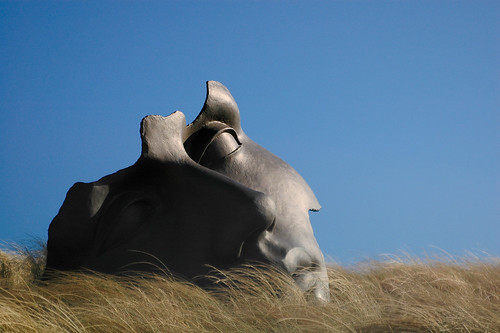
Scheveningen is one of the eight districts of The Hague; with many cute seaside restaurants, long beaches, kite surfers, a pier (with casino) and lots of art scattered everywhere. This one here by Igor Mitoraj is looking out to the North Sea. For some info about art exhibits in Scheveningen, go to beeldenaanzee.nl.
- - - - - - - -
Igor Mitoraj (born 1944) is a Polish artist born in Oederan, Germany.
He studied painting at the Kraków School of Art and at the Kraków Academy of Art under Tadeusz Kantor. After graduating, he had several joint exhibitions, and held is first solo exhibition in 1967 at the Krzysztofory Gallery in Poland. In 1968, he moved to Paris to continue his studies at the National School of Art.
Shortly afterwards, he became fascinated by Latin American art and culture, spending a year painting and travelling around Mexico. The experience led him to take up sculpture.
He returned to Paris in 1974 and two years later he held another major solo exhibition at the Gallery La Hune, including some sculptural work. The success of the show persuaded him that he was first and foremost a sculptor.
Having previously worked with terracotta and bronze, a trip to Carrara, Italy, in 1979 turned him to using marble as his primary medium and in 1983 he set up a studio in Pietrasanta. In 2006, he created the new bronze doors and a statue of John the Baptist for the basilica of Santa Maria degli Angeli in Rome. However report hot controversy as a result of installation (April 5 2008) of his work in Piazza Trento in Tivoli, opposite the church of St. Maria Maggiore and the Villa d'Este. The location of the fact has put at risk the celebration of the rite dell'Inchinata. The work was moved on August 11, in this way was made possible the sacred ceremony. The statue was then called in situ on August 20, 2008. The citizens of Tivoli, which already signed a petition People (4800 signatures, the source Il Messaggero) against the installation of sculpture, even aesthetically and historically totally alien to the site, hope that in future the removal can be definitive.

 Testa Addormentata located in Canada Square, Canary Wharf, London

Today on the radio in the United States reported that no deaths have happened like in Mexico ... because early detection and proper treatment are essential. Reportedly died in Mexico because so many people even had the technology to diagnose early. Besides the high cost of medicines.
-- ---------- ---------- ---------- ---------- --
Flu spreads around the world in seasonal epidemics, resulting in the deaths of hundreds of thousands annually — millions in pandemic years. Three influenza pandemics occurred in the 20th century and killed tens of millions of people, with each of these pandemics being caused by the appearance of a new strain of the virus in humans. Often, these new strains result from the spread of an existing flu virus to humans from other animal species. An avian strain named H5N1 had until recently posed the greatest risk for a new influenza pandemic since it first killed humans in Asia in the 1990s. Although H5N1 virus has not mutated to a form that spreads easily between people , in April 2009 a novel H1N1 flu strain that combined genes from human, pig, and bird flu, initially dubbed the "swine flu," emerged in Mexico, the United States, and several other nations. By late April, the H1N1 swine flu was suspected of having killed over 150 in Mexico, and prompted Mexico and U.S. travel advisories.
http://en.wikipedia.org/wiki/Influenza

“Man is a microcosm, or a little world, because he is an extract from all the stars and planets of the whole firmament, from the earth and the elements; and so he is their quintessence”
- Philipus Aureolus Paracelsus
Or does the tree of life dream Gaia?
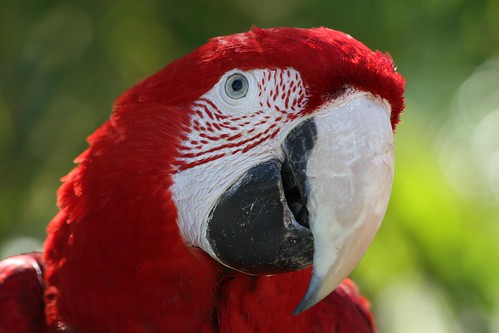
It is native to humid evergreen forests in the American tropics. Range extends from extreme south - eastern Mexico to Amazoniain Peru and Brazil, in lowlands up to 500 m (1,640 ft) (at least formerly) up to 1,000 m (3,281 ft). It has been widely extirpated by habitat destruction and capture for the pet trade. Formerly it ranged north to southern Tamaulipas. It can still be found on the island of Coiba. It is also the Honduran national bird.
It is about 81 to 96 cm (32 to 36 inches) long, of which more than half is the pointed, graduated tail typical of all macaws. The average weight is about a kilogram (2 to 2.5 pounds). The plumage is mostly scarlet, but the rump and tail-covert feathers are light blue, the greater upperwing coverts are yellow, the upper sides of the flight feathers of the wings are dark blue as are the ends of the tail feathers, and the undersides of the wing and tail flight feathers are dark red with metallic gold iridescence. Some individuals may have green on the wings near the yellow band. Three subspecies present varying widths in their yellow wing band. There is bare white skin around the eye and from there to the bill. Tiny white feathers are contained on the face patch. The upper mandible is mostly pale horn in color and the lower is black. Sexes are alike; the only difference between ages is that young birds have dark eyes, and adults have light yellow eyes.
Scarlet Macaws make loud, low-pitched, throaty squawks, squeaks and screams designed to carry many miles.

Two Scarlet Macaws at the Henry Doorly Zoo in Omaha, Nebraska.
Before the Scarlet Macaw's decline in population, its distribution included much of Costa Rica. However, by the 1960s Scarlet Macaws had been decreasing in numbers due to a combination of factors, particularly hunting, poaching, and the destruction of habitat through deforestation. Further, the spraying of pesticides by companies cultivating and selling bananas for export played a significant role in decreasing Scarlet Macaw populations.
The combined factors stressed the population of Scarlet Macaws in Costa Rica, where they had previously occupied approximately 42,500 km² of the country's total national territory of 51,100 km², leaving viable populations in the early 1990s isolated to only two regions on the Pacific Coast of Costa Rica; the Carara Biological Reserve and Peninsula de Osa. By 1993 surveys had shown Scarlet macaws occupied only 20% (9,100 km²) of their historic range in Costa Rica.


MARKET NEAR XOCHIMILCO DISTRICT, MEXICO CITY, MEXICO (19°20’ N, 99°05’ W)
This mosaic of brightly colored parasols hides a bustling, noisy market, set up for the day in a street of the capital. Shaded from the sun, stalls selling fruit and vegetables, herbal remedies, and spices sit side by side with others that sell cloth and craft artifacts. Mexico’s flourishing markets are a national institution, held daily all over the country. Like their crafts, their traditional clothing, and the façades of buildings, the markets express Mexicans’ love of vivid, bright colors, such as the brilliant pink known as «rosa Mexicana.» Internationally, Mexico was a world champion of commercial growth between 1985 and 1999. Although the national GDP doubled during this period, it is only today that household consumption has begun to rise. This trend may benefit some of the wealthier urban population, but life has not improved for the majority of Mexicans, half of whom live below the poverty line. The social unrest that has troubled the state of Chiapas since 1994 is partly due to this.













%5B1%5D.jpg)