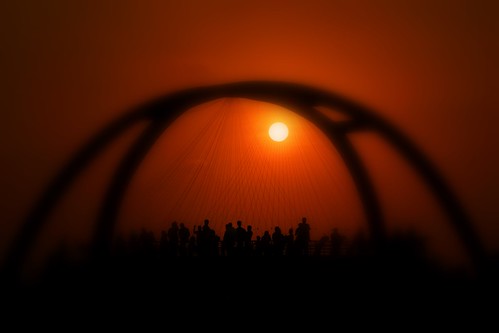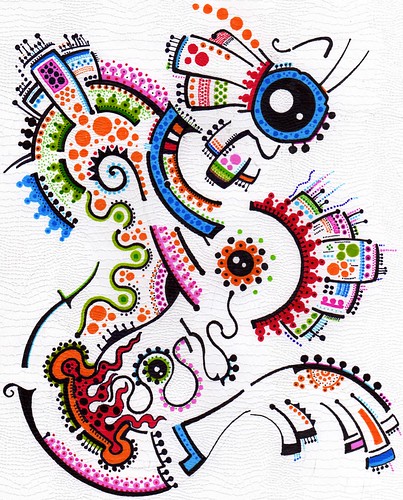
The art of Light on Water- Chinese Lanternes de Chine , inserito originariamente da herberouge1 somewhere over the rainbow.

The art of Light on Water- Chinese Lanternes de Chine

The art of Light on Water- Chinese Lanternes de Chine

The cheetah (Acinonyx jubatus) is an atypical member of the cat family (Felidae) that is unique in its speed, while lacking climbing abilities. The species is the only living member of the genus Acinonyx. It is the fastest land animal, reaching speeds between 112 and 120 km/h (70 and 75 mph) in short bursts covering distances up to 460 m (1,500 ft), and has the ability to accelerate from 0 to 103 km/h (64 mph) in three seconds, faster than most supercars. Recent studies confirm the cheetah's status as the fastest land animal.
The word "cheetah" is derived from the Sanskrit word citrakāyaḥ, meaning "variegated body", via the Hindi चीता cītā.
The cheetah's chest is deep and its waist is narrow. The coarse, short fur of the cheetah is tan with round black spots measuring from 2 to 3 cm (0.79 to 1.2 in) across, affording it some camouflage while hunting. There are no spots on its white underside, but the tail has spots, which merge to form four to six dark rings at the end. The tail usually ends in a bushy white tuft. The cheetah has a small head with high-set eyes. Black "tear marks" run from the corner of its eyes down the sides of the nose to its mouth to keep sunlight out of its eyes and to aid in hunting and seeing long distances. Although it can reach high speeds, its body cannot stand long distance running. It is a sprinter.
The adult cheetah weighs from 40 to 65 kg (88 to 140 lb). Its total body length is from 115 to 135 cm (45 to 53 in), while the tail can measure up to 84 cm (33 in) in length. Males tend to be slightly larger than females and have slightly bigger heads, but there is not a great variation in cheetah sizes and it is difficult to tell males and females apart by appearance alone. Compared to a similarly-sized leopard, the cheetah is generally shorter-bodied, but is longer tailed and taller (it averages about 90 cm (35 in) tall) and so it appears more streamlined.
Some cheetahs also have a rare fur pattern mutation: cheetahs with larger, blotchy, merged spots are known as 'king cheetahs'. It was once thought to be a separate subspecies, but it is merely a mutation of the African cheetah. The 'king cheetah' has only been seen in the wild a handful of times, but it has been bred in captivity.
The cheetah's paws have semi-retractable claws (known only in three other cat species: the Fishing Cat, the Flat-headed Cat and the Iriomote Cat) offering extra grip in its high-speed pursuits. The ligament structure of the cheetah's claws is the same as those of other cats; it simply lacks the sheath of skin and fur present in other varieties, and therefore the claws are always visible, with the exception of the dewclaw. The dewclaw itself is much shorter and straighter than that of other cats.
Adaptations that enable the cheetah to run as fast as it does include large nostrils that allow for increased oxygen intake, and an enlarged heart and lungs that work together to circulate oxygen efficiently. During a typical chase its respiratory rate increases from 60 to 150 breaths per minute. While running, in addition to having good traction due to its semi-retractable claws, the cheetah uses its tail as a rudder-like means of steering[citation needed] to allow it to make sharp turns, necessary to outflank prey animals that often make such turns to escape.
Unlike "true" big cats, the cheetah can purr as it inhales, but cannot roar. By contrast, the big cats can roar but cannot purr, except while exhaling. However, the cheetah is still considered by some to be the smallest of the big cats. While it is often mistaken for the leopard, the cheetah does have distinguishing features, such as the aforementioned long "tear-streak" lines that run from the corners of its eyes to its mouth. The body frame of the cheetah is also very different from that of the leopard, most notably so in its thinner and longer tail and, unlike the leopard's, its spots are not arranged into rosettes.
The cheetah is a vulnerable species. Out of all the big cats, it is the least able to adapt to new environments. It has always proved difficult to breed in captivity, although recently a few zoos have managed to succeed at this. Once widely hunted for its fur, the cheetah now suffers more from the loss of both habitat and prey.
The cheetah was formerly considered to be particularly primitive among the cats and to have evolved approximately 18 million years ago. New research, however, suggests that the last common ancestor of all 40 existing species of felines lived more recently than that—about 11 million years ago. The same research indicates that the cheetah, while highly derived morphologically, is not of particularly ancient lineage, having separated from its closest living relatives (Puma concolor, the cougar, and Puma yaguarondi, the jaguarundi) around five million years ago. These felids haven't changed much since they first appeared in the fossil record.
Baby Cheetah dozing off!

There are several geographically isolated populations of cheetah, all of which are found in Africa or Southwestern Asia. A small population (estimated at about fifty) survive in the Khorasan Province of Iran, where conservationists are taking steps to protect them. It is possible, though doubtful, that some cheetahs remain in India. There have also been several unconfirmed reports of Asiatic Cheetahs in the Balochistan province of Pakistan, with at least one dead animal being discovered recently.
The cheetah thrives in areas with vast expanses of land where prey is abundant. The cheetah likes to live in an open biotope, such as semi-desert, prairie, and thick brush, though it can be found in a variety of habitats. In Namibia, for example, it lives in grasslands, savannahs, areas of dense vegetation, and mountainous terrain.
In much of its former range, the cheetah was tamed by aristocrats and used to hunt antelopes in much the same way as is still done with members of the greyhound group of dogs.
Females reach maturity in twenty to twenty-four months, and males around twelve months (although they do not usually mate until at least three years old), and mating occurs throughout the year. A study of cheetahs in the Serengeti showed that females are sexually promiscuous and often have cubs by many different males.
Females give birth to up to nine cubs after a gestation period of ninety to ninety-eight days, although the average litter size is three to five. Cubs weigh from 150 to 300 g (5.3 to 11 oz) at birth. Unlike some other cats, the cheetah is born with its characteristic spots. Cubs are also born with a downy underlying fur on their necks, called a mantle, extending to mid-back. This gives them a mane or Mohawk-type appearance; this fur is shed as the cheetah grows older. It has been speculated that this mane gives a cheetah cub the appearance of the Honey Badger (Ratel), to scare away potential aggressors. Cubs leave their mother between thirteen and twenty months after birth. Life span is up to twelve years in the wild, but up to twenty years in captivity.
Unlike males, females are solitary and tend to avoid each other, though some mother/daughter pairs have been known to be formed for small periods of time. The cheetah has a unique, well-structured social order. Females live alone except when they are raising cubs and they raise their cubs on their own. The first eighteen months of a cub's life are important; cubs learn many lessons because survival depends on knowing how to hunt wild prey species and avoid other predators. At eighteen months, the mother leaves the cubs, who then form a sibling, or "sib" group, that will stay together for another six months. At about two years, the female siblings leave the group, and the young males remain together for life.
Males are very sociable and will group together for life, usually with their brothers in the same litter; although if a cub is the only male in the litter then two or three lone males may group up, or a lone male may join an existing group. These groups are called coalitions. In one Serengeti study by Caro and Collins (1987), 41% of the adult males were solitary, 40% lived in pairs and 19% lived in trios.
A coalition is six times more likely to obtain an animal territory than a lone male, although studies have shown that coalitions keep their territories just as long as lone males—between four and four and a half years.
Males are very territorial. Females' home ranges can be very large and trying to build a territory around several females' ranges is impossible to defend. Instead, males choose the points at which several of the females' home ranges overlap, creating a much smaller space, which can be properly defended against intruders while maximizing the chance of reproduction. Coalitions will try their best to maintain territories in order to find females with whom they will mate. The size of the territory also depends on the available resources; depending on the part of Africa, the size of a male's territory can vary greatly from 37 to 160 km2 (14 to 62 sq mi).
Males mark their territory by urinating on objects that stand out, such as trees, logs, or termite mounds. The whole coalition contributes to the scent. Males will attempt to kill any intruders and fights result in serious injury or death.
Unlike males and other felines, females do not establish territories. Instead, the area they live in is termed a home range. These overlap with other females' home ranges, often those of their daughters, mothers, or sisters. Females always hunt alone, although cubs will accompany their mothers to learn to hunt once they reach the age of five to six weeks.
The size of a home range depends entirely on the availability of prey. Cheetahs in southern African woodlands have ranges as small as 34 km2 (13 sq mi), while in some parts of Namibia they can reach 1,500 km2 (580 sq mi).
The cheetah cannot roar, but does have the following vocalizations:
Despite their speed and hunting prowess, cheetahs are largely outranked by other large predators in most of their range. Because they have evolved for short bursts of extreme speed at the expense of both power and the ability to climb trees, they cannot defend themselves against most of Africa's other predator species. They usually avoid fighting and will surrender a kill immediately to even a single hyena, rather than risk injury. Because cheetahs rely on their speed to obtain their meals, any injury that slows them down could essentially be life threatening.
A cheetah has a 50% chance of losing its kill to other predators. Cheetahs avoid competition by hunting at different times of the day and by eating immediately after the kill. Due to the reduction in habitat in Africa, Cheetahs in recent years have faced greater pressure from other native African predators as available range declines.[citation needed]
The cheetah's mortality is very high during the early weeks of its life; up to 90% of cheetah cubs are killed during this time by lions, leopards, hyenas, wild dogs, or even by eagles. Cheetah cubs often hide in thick brush for safety. Mother cheetahs will defend their young and are at times successful in driving predators away from their cubs. Coalitions of male cheetahs can also chase away other predators, depending on the coalition size and the size and number of the predator. Because of its speed, a healthy adult cheetah has few predators.
The cheetah is a carnivore, eating mostly mammals under 40 kg (88 lb), including the Thomson's Gazelle, the Grant's gazelle, the springbok and the impala. The young of larger mammals such as wildebeests and zebras are taken at times, and adults too, when the cats hunt in groups. Guineafowl and hares are also prey. While the other big cats mainly hunt by night, the cheetah is a diurnal hunter. It hunts usually either early in the morning or later in the evening when it is not so hot, but there is still enough light.
The cheetah hunts by vision rather than by scent. Prey is stalked to within 10–30 m (33–98 ft), then chased. This is usually over in less than a minute, and if the cheetah fails to make a catch quickly, it will give up. The cheetah has an average hunting success rate of around 50% - half of its chases result in failure.
Running at speeds between 112 and 120 km/h (70 and 75 mph) puts a great deal of strain on the cheetah's body. When sprinting, the cheetah's body temperature becomes so high that it would be deadly to continue; this is why the cheetah is often seen resting after it has caught its prey. If it is a hard chase, it sometimes needs to rest for half an hour or more. The cheetah kills its prey by tripping it during the chase, then biting it on the underside of the throat to suffocate it, for the cheetah is not strong enough to break the necks of the four-legged prey it mainly hunts. The bite may also puncture a vital artery in the neck. Then the cheetah proceeds to devour its catch as quickly as possible before the kill is taken by stronger predators.
The diet of a cheetah is dependent upon the area in which it lives. For example, on the East African plains, its preferred prey is the Thomson's Gazelle. This small antelope is shorter than the cheetah (about 58–70 cm (23–28 in) tall and 70–107 cm (28–42 in) long), and also cannot run faster than the cheetah (only up to 80 km/h (50 mph)), which combine to make it an appropriate prey. Cheetahs look for individuals which have strayed some distance from their group, and do not necessarily seek out old or weak ones.
The genus name, Acinonyx, means "no-move-claw" in Greek, while the species name, jubatus, means "maned" in Latin, a reference to the mane found in cheetah cubs.
The cheetah has unusually low genetic variability and a very low sperm count, which also suffers from low motility and deformed flagellae. Skin grafts between non-related cheetahs illustrate this point in that there is no rejection of the donor skin. It is thought that it went through a prolonged period of inbreeding following a genetic bottleneck during the last ice age. It probably evolved in Africa during the Miocene epoch (26 million to 7.5 million years ago), before migrating to Asia. New research by a team led by Warren Johnson and Stephen O'Brien of the Laboratory of Genomic Diversity (National Cancer Institute in Frederick, Maryland, United States) has recently placed the last common ancestor of all existing species as living in Asia 11 million years ago, which may lead to revision and refinement of existing ideas about cheetah evolution. Now-extinct species include: Acinonyx pardinensis (Pliocene epoch), much larger than the modern cheetah and found in Europe, India, and China; Acinonyx intermedius (mid-Pleistocene period), found over the same range. The extinct genus Miracinonyx was extremely cheetah-like, but recent DNA analysis has shown that Miracinonyx inexpectatus, Miracinonyx studeri, and Miracinonyx trumani (early to late Pleistocene epoch), found in North America and called the "North American cheetah" are not true cheetahs, instead being close relatives to the cougar.
The king cheetah is a rare mutation of cheetah characterized by a distinct pelt pattern. It was first noted in Zimbabwe in 1926. In 1927, the naturalist Reginald Innes Pocock declared it a separate species, but reversed this decision in 1939 due to lack of evidence, but in 1928, a skin purchased by Walter Rothschild was found to be intermediate in pattern between the king cheetah and spotted cheetah and Abel Chapman considered it to be a color form of the spotted cheetah. Twenty-two such skins were found between 1926 and 1974. Since 1927, the king cheetah was reported five more times in the wild. Although strangely marked skins had come from Africa, a live king cheetah was not photographed until 1974 in South Africa's Kruger National Park. Cryptozoologists Paul and Lena Bottriell photographed one during an expedition in 1975. They also managed to obtain stuffed specimens. It appeared larger than a spotted cheetah and its fur had a different texture. There was another wild sighting in 1986—the first in seven years. By 1987, thirty-eight specimens had been recorded, many from pelts.
Its species status was resolved in 1981 when king cheetahs were born at the De Wildt Cheetah and Wildlife Centre in South Africa. In May 1981, two spotted sisters gave birth there and each litter contained one king cheetah. The sisters had both mated with a wild-caught male from the Transvaal area (where king cheetahs had been recorded). Further king cheetahs were later born at the Centre. It has been known to exist in Zimbabwe, Botswana and in the northern part of South Africa's Transvaal province. A recessive gene must be inherited from both parents in order for this pattern to appear- which is one reason why it is so rare.
Other rare color morphs of the species include speckles, melanism, albinism and gray coloration. Most have been reported in Indian cheetahs, particularly in captive specimens kept for hunting.
The Mughal Emperor of India, Jahangir, recorded having a white cheetah presented to him in 1608. In the memoirs of Tuzk-e-Jahangiri, the Emperor says that in the third year of his reign: Raja Bir Singh Deo brought a white cheetah to show me. Although other sorts of creatures, both birds and beasts have white varieties .... I had never seen a white cheetah. Its spots, which are (usually) black, were of a blue colour, and the whiteness of the body also inclined to blue-ishness. This suggests a chinchilla mutation which restricts the amount of pigment on the hair shaft. Although the spots were formed of black pigment, the less dense pigmentation gives a hazy, grayish effect. As well as Jahangir's white cheetah at Agra, a report of "incipient albinism" has come from Beaufort West according to Guggisberg.
In a letter to "Nature in East Africa", H. F. Stoneham reported a melanistic cheetah (black with ghost markings) in the Trans-Nzoia District of Kenya in 1925. Vesey Fitzgerald saw a melanistic cheetah in Zambia in the company of a spotted cheetah. Red (erythristic) cheetahs have dark tawny spots on a golden background. Cream (isabelline) cheetahs have pale red spots on a pale background. Some desert region cheetahs are unusually pale; probably they are better-camouflaged and therefore better hunters and more likely to breed and pass on their paler coloration. Blue (Maltese or grey) cheetahs have variously been described as white cheetahs with grey-blue spots (chinchilla) or pale grey cheetahs with darker grey spots (Maltese mutation). A cheetah with hardly any spots was shot in Tanzania on 1921 (Pocock), it had only a few spots on the neck and back and these were unusually small.
Cheetah fur was formerly regarded as a status symbol. Today, cheetahs have a growing economic importance for ecotourism and they are also found in zoos. Cheetahs are far less aggressive than other cat-like mammals and can be tamed, so cubs are sometimes illegally sold as pets.
Cheetahs were formerly, and sometimes still are, hunted because many farmers believe that they eat livestock. When the species came under threat, numerous campaigns were launched to try to educate farmers and encourage them to conserve cheetahs. Recent evidence has shown that cheetahs will not attack and eat livestock if they can avoid doing so, as they prefer their wild prey. However, they have no problem with including farmland as part of their territory, leading to conflict.
Ancient Egyptians often kept cheetahs as pets, and also tamed and trained them for hunting. Cheetahs would be taken to hunting fields in low-sided carts or by horseback, hooded and blindfolded, and kept on leashes while dogs flushed out their prey. When the prey was near enough, the cheetahs would be released and their blindfolds removed. This tradition was passed on to the ancient Persians and brought to India, where the practice was continued by Indian princes into the twentieth century. Cheetahs continued to be associated with royalty and elegance, their use as pets spreading just as their hunting skills were. Other such princes and kings kept them as pets, including Genghis Khan and Charlemagne, who boasted of having kept cheetahs within their palace grounds. Akbar the Great, ruler of the Mughal Empire from 1556 to 1605, kept as many as 1000 cheetahs.[8] As recently as the 1930s the Emperor of Ethiopia, Haile Selassie, was often photographed leading a cheetah by a leash.
Cheetah cubs have a high mortality rate due to genetic factors and predation by carnivores in competition with the cheetah, such as the lion and hyena. Recent inbreeding causes cheetahs to share very similar genetic profiles. This has led to poor sperm, birth defects, cramped teeth, curled tails, and bent limbs. Some biologists now believe that they are too inbred to flourish as a species.[18]
Cheetahs are included on the International Union for Conservation of Nature (IUCN) list of vulnerable species (African subspecies threatened, Asiatic subspecies in critical situation) as well as on the US Endangered Species Act: threatened species - Appendix I of CITES (Convention on International Trade in Endangered Species). Approximately 12,400 cheetahs remain in the wild in twenty-five African countries; Namibia has the most, with about 2,500. Another fifty to sixty critically endangered Asiatic Cheetahs are thought to remain in Iran. There have been successful breeding programs, including the use of in vitro fertilisation, in zoos around the world.
Founded in Namibia in 1990, the Cheetah Conservation Fund's mission is to be an internationally recognized centre of excellence in research and education on cheetahs and their eco-systems, working with all stakeholders to achieve best practice in the conservation and management of the world's cheetahs. The CCF has also set stations throughout South Africa in order to keep the conservation effort going. The Cheetah Conservation Foundation, a South African based organisation, was set up in 1993 for cheetah protection.
Cheetahs have known to exist in India for a very long time. But due to hunting and other purposes, Cheetahs in India became extinct before the twentieth century. Hence, the Indian government is planning a re-wilding project for Cheetahs. The article in TOI, Page 11, Thursday, July 9, 2009 clearly suggests the import of Cheetahs in India where they will be bred in captivity. Cheetahs have been extinct in India since the 1940s, and hence the government is planning apon this project. Environment and forests minister Jairam Ramesh told the Rajya Sabha on 7 July 2009 that, "The cheetah is the only animal that has been described extinct in India in the last 100 years. We have to get them from abroad to repopulate the species." He was responding to a calling attention notice from Rajiv Pratap Rudy of BJP. 'The plan to bring back the Cheetah which fell to indiscriminate hunting and complex factors like a fragile breeding pattern is audacious given the problems besetting tiger conservation.' Two naturalists Divya Bhanusinh and MK Ranjit Singh suggested the idea of importing cheetahs from Africa. After their import they will be bred in captivity and after a definite period of time, released in the wild.
Baby Cheetah
Mercedes Sosa canta Gracias a la Vida - Letra de Violeta Parra - http://pt.wikipedia.org/wiki/Violeta_...
Gracias a la Vida que me ha dado tanto
me dio dos luceros que cuando los abro
perfecto distingo lo negro del blanco
y en el alto cielo su fondo estrellado
y en las multitudes el hombre que yo amo.
Gracias a la vida, que me ha dado tanto
me ha dado el oido que en todo su ancho
graba noche y dia grillos y canarios
martillos, turbinas, ladridos, chubascos
y la voz tan tierna de mi bien amado.
Gracias a la Vida que me ha dado tanto
me ha dado el sonido y el abedecedario
con él las palabras que pienso y declaro
madre amigo hermano y luz alumbrando,
la ruta del alma del que estoy amando.
Gracias a la Vida que me ha dado tanto
me ha dado la marcha de mis pies cansados
con ellos anduve ciudades y charcos,
playas y desiertos montañas y llanos
y la casa tuya, tu calle y tu patio.
Gracias a la Vida que me ha dado tanto
me dio el corazón que agita su marco
cuando miro el fruto del cerebro humano,
cuando miro el bueno tan lejos del malo,
cuando miro el fondo de tus ojos claros.
Gracias a la Vida que me ha dado tanto
me ha dado la risa y me ha dado el llanto,
asi yo distingo dicha de quebranto
los dos materiales que forman mi canto
y el canto de ustedes que es el mismo canto
y el canto de todos que es mi propio canto.
Gracias a la Vida
Gracias a la Vida
Gracias a la Vida
Gracias a la Vida
Translate to English:
Mercedes Sosa - Thanks to life (Violeta Parra)
Thanks to life, which has given me so much.
It gave me two beams of light, that when opened,
Can perfectly distinguish black from white
And in the sky above, her starry backdrop,
And from within the multitude
The one that I love.
Thanks to life, which has given me so much.
It gave me an ear that, in all of its width
Records— night and day—crickets and canaries,
Hammers and turbines and bricks and storms,
And the tender voice of my beloved.
Thanks to life, which has given me so much.
It gave me sound and the alphabet.
With them the words that I think and declare:
"Mother," "Friend," "Brother" and the light shining.
The route of the soul from which comes love.
Thanks to life, which has given me so much.
It gave me the ability to walk with my tired feet.
With them I have traversed cities and puddles
Valleys and deserts, mountains and plains.
And your house, your street and your patio.
Thanks to life, which has given me so much.
It gave me a heart, that causes my frame to shudder,
When I see the fruit of the human brain,
When I see good so far from bad,
When I see within the clarity of your eyes...
Thanks to life, which has given me so much.
It gave me laughter and it gave me longing.
With them I distinguish happiness and pain—
The two materials from which my songs are formed,
And your song, as well, which is the same song.
And everyone's song, which is my very song.
Thanks to life
Thanks to life
Thanks to life
Thanks to life
Tradução para Português:
Mercedes Sosa - Obrigado à vida (Violeta Parra)
Obrigado à vida que me tem dado tanto
deu-me dois olhos que, quando os abro
perfeitamente distingo o preto do branco
e no alto céu, o seu fundo estrelado
e nas multidões, o homem que eu amo.
Obrigado à vida que me tem dado tanto
deu-me o ouvido que, em toda a amplitude,
grava, noite e dia, grilos e canários
martelos, turbinas, latidos, chuviscos
e a voz tão terna do meu bem amado.
Obrigado à vida que me tem dado tanto
deu-me o som e o abecedário
e, com ele, as palavras com que penso e falo
mãe, amigo, irmão e luz iluminando
a rota da alma de quem estou amando.
Obrigado à vida que me tem dado tanto
deu-me a marcha dos meus pés cansados
com eles andei por cidades e charcos,
praias e desertos, montanhas e planícies
pela tua casa, tua rua e teu pátio.
Obrigado à vida que me tem dado tanto
deu-me o coração que todo se agita
quando vejo o fruto do cérebro humano,
quando vejo o bem tão longe do mal,
quando vejo no fundo do teus olhos claros.
Obrigado à vida que me tem dado tanto
deu-me o riso e deu-me o pranto
assim eu distingo a felicidade da tristeza,
os dois materiais de que é feito o meu canto
e o canto de todos, que é o meu próprio canto
Obrigado à Vida
Obrigado à Vida
Obrigado à Vida
Obrigado à Vida
Mercedes Sosa - Gracias a La Vida
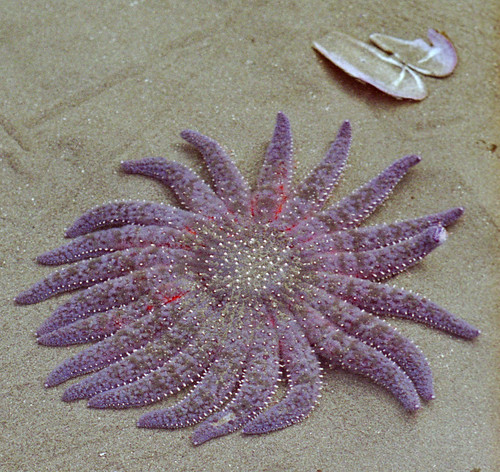
A sunflower star waits for the tide onthe beach at South Cove at Cape Arago on the Oregon Coast. I should have spent more time with this star, but I was on my way back up to the trail. I am fascinated by the sand tracks the star made when it the tide went out under it. These creatures came move fairly fast for a sea star, but this one was too far from solid rock to make any headway. Hopefully the tide returned before the birds got to it.
It Came From the Sea
21 Armed Sunflower Starfish at Quillayute Needles. Olympic National Park.
21 Arms at Quillayute Needles
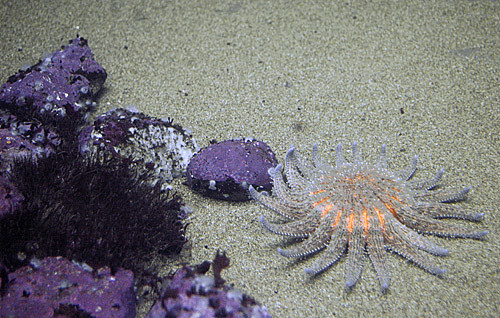
Taken at the Seattle Aquarium
The sunflower sea star (Pycnopodia helianthoides) is a large predatory sea star usually with 16-24 limbs called rays. It is the largest sea star in the world. Sunflower sea stars can grow to have an arm span of 1 m (3 ft.) in diameter.[1] The color of the sunflower sea star ranges from bright orange, yellow and red to brown and sometimes to purple, with soft, velvet-textured bodies and 16-24 arms with powerful suckers. Most sea star species have a mesh-like skeleton that protects their internal organs. Easily stressed by predators such as large fish and other sea stars, they can shed arms to escape, which will grow back within a few weeks. They are part of the diet of the king crab.
The sunflower sea stars are quick, efficient hunters, moving at a speed of one meter per minute, using 15,000 tube feet which lie on the undersides of the body. They commonly hang around urchin barrens, as the sea urchin is a favorite food. They also eat clams, snails, abalone, sea cucumbers and other sea stars. In Monterey Bay, California, they will feed upon dead or dying squid. Although the sunflower sea star can greatly extend its mouth, for larger prey, the stomach can extend outside the mouth to digest prey, such as gastropods like abalone. Their feeding behavior was filmed in the 2006 BBC nature documentary, Planet Earth.
http://en.wikipedia.org/wiki/Sunflower_starfish
Sunflower starfish
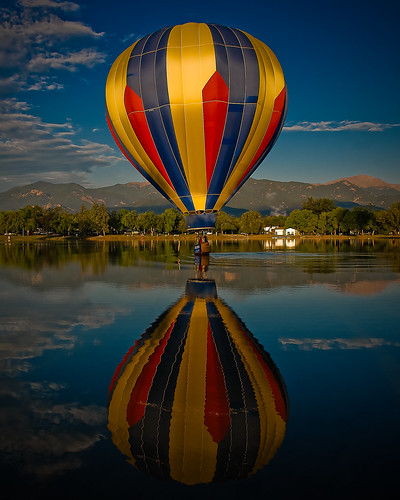
Colorado Balloon Classic - Day 2
I'm still screwed up from jet lag so when I was reminded of the Balloon Classic by the Colorado Springs Gazette (at 3am) I decided to sneak out of the house to check it out around 7. I'm taking the family tomorrow morning.
Colorado Balloon Classic - Day 1
© 2008 by Vikram Ramakrishnan - all rights reserved
made explore on Jul 10, 2007 #350
anjali's beautiful mehndi creation
We
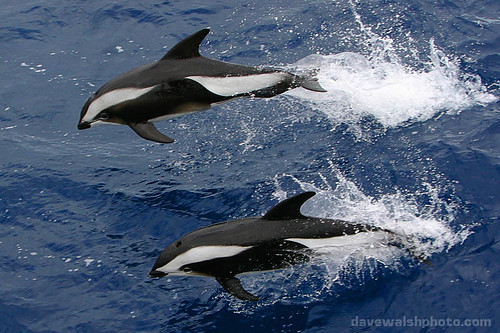
Two Hourglass dolphins breaching, Southern Ocean
27/02/2007
Breaching Hourglass Dolphins
(FILES): This February 12, 1996 file photo shows US pop star Michael Jackson (L) performing during the filming of his video "They Don't Care About Us" in Rio de Janeiro with a view of the city in the background. Pop icon Michael Jackson died on June 25, 2009 after suffering a cardiac arrest, multiple US media outlets reported, sending shockwaves around the entertainment world. AFP PHOTO / Files.
RIP Michael Jackson - FILES-BRAZIL-MUSIC-JACKSON
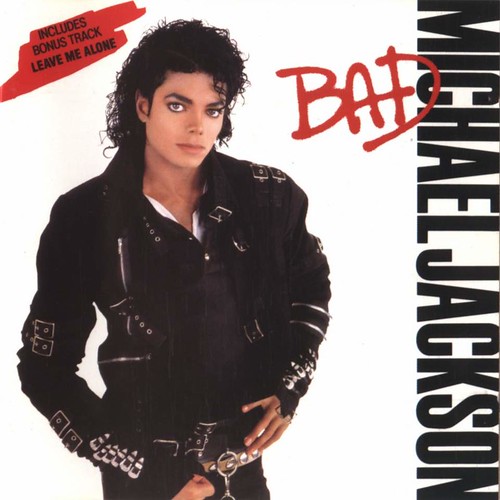
Michael Joseph Jackson (August 29, 1958 – June 25, 2009) was an American recording artist, entertainer, and businessman. The seventh child of the Jackson family, he debuted on the professional music scene at the age of 11 as a member of The Jackson 5 and began a solo career in 1971 while still a member of the group. Referred to as the "King of Pop" in subsequent years, his 1982 Thriller is the world's best-selling record of all time and four other solo studio albums are also among the world's best-selling records: Off the Wall(1979), Bad (1987), Dangerous (1991) and HIStory (1995).
In the early 1980s, he became a dominant figure in popular music and the first African-American entertainer to amass a strong crossoverfollowing on MTV. The popularity of his music videos airing on MTV, such as "Beat It", "Billie Jean" and Thriller—widely credited with transforming the music video from a promotional tool into an art form—helped bring the relatively new channel to fame. Videos such as "Black or White" and "Scream" made Jackson an enduring staple on MTV in the 1990s. With stage performances and music videos, Jackson popularized a number of physically complicated dance techniques, such as the robot and the moonwalk. His distinctive musical sound and vocal style influenced many hip hop, pop and contemporary R&B artists.
Jackson donated and raised millions of dollars for beneficial causes through his foundation, charity singles and support of 39 charities. Other aspects of his personal life, including his changing appearance and behavior, generated significant controversy, damaging his public image. Though he was accused of child sexual abuse in 1993, the criminal investigation was closed due to lack of evidence and Jackson was not charged. The singer had experienced health concerns since the early 1990s and conflicting reports regarding the state of his finances since the late 1990s. Jackson married twice and fathered three children, all of which caused further controversy. In 2005, Jackson was tried and acquitted of further sexual abuse allegations and several other charges.
One of the few artists to have been inducted into the Rock and Roll Hall of Fame twice, his other achievements include multiple Guinness World Records—including one for "Most Successful Entertainer of All Time"—13 Grammy Awards, 13 number one singles in his solo career—more than any other male artist in the Hot 100 era and the sale of 750 million records worldwide. Jackson's highly publicized personal life, coupled with his successful career, made him a part of popular culture for almost four decades. Jackson died on June 25, 2009, aged 50. The specific cause of death has yet to be determined. Prior to his death, Jackson had announced a 50 date sell-outThis Is It comeback tour, in London, England.
Steve Huey of Allmusic asserts that throughout his solo career, Jackson's versatility allowed him to experiment with various themes and genres. As a musician, he ranged fromMotown's dance fare and ballads to techno-edged new jack swing to work that incorporates both funk rhythms and hard rock guitar. Unlike many artists, Jackson did not write his songs on paper. Instead he would dictate into a sound recorder; when recording he would sing from memory Several critics observed Off the Wall was crafted from funk, disco-pop, soul, soft rock, jazz and pop ballads. Prominent examples include the ballad "She's out of My Life", and the two disco tunes "Workin' Day and Night" and "Get on the Floor".
According to Huey, Thriller refined the strengths of Off the Wall; the dance and rock tracks were more aggressive, while the pop tunes and ballads were softer and more soulful. Notable tracks included the ballads "The Lady in My Life", "Human Nature" and "The Girl Is Mine"; the funk pieces "Billie Jean" and "Wanna Be Startin' Somethin'"; and the disco set "Baby Be Mine" and "P.Y.T. (Pretty Young Thing)". With Thriller, Christopher Connelly of Rolling Stone commented that Jackson developed his long association with the subliminal theme of paranoia and darker imagery. Allmusic's Stephen Thomas Erlewine noted this is evident on the songs "Billie Jean" and "Wanna Be Startin' Somethin'" In "Billie Jean", Jackson sings about an obsessive fan who alleges he has fathered a child of hers In "Wanna Be Startin' Somethin'" he argues against gossip and the media. The anti-gang violence rock song "Beat It" became a homage to West Side Story, and was Jackson's first successful rock cross-over piece, according to Huey. He also observed that the title track "Thriller" began Jackson's interest with the theme of the supernatural, a topic he revisited in subsequent years. In 1985, Jackson wrote the charity anthem "We Are the World"; humanitarian themes later became a central component of his life and music.
| |||||||||
| Problems listening to these files? See media help. | |||||||||
In Bad, Jackson's concept of the predatory lover can be seen on the rock song "Dirty Diana". The lead single "I Just Can't Stop Loving You" was a traditional love ballad, while "Man in the Mirror", an anthemic ballad of confession and resolution, improved on his earlier "We Are the World". "Smooth Criminal" was an evocation of bloody assault, rape and likely murder. Allmusic's Stephen Thomas Erlewine states that Dangerous presents Jackson as a stark paradoxical individual. He comments the album is more diverse than his previous Bad, as it appeals to an urban audience while also attracting the middle class with anthems like "Heal the World". The first half of the record is dedicated to new jack swing, including songs like "Jam" and "Remember the Time".The album is Jackson's first where social ills become a primary theme; "Why You Wanna Trip on Me", for example, protests against world hunger, AIDS, homelessness and drugs.Dangerous contains sexually charged efforts like "In the Closet", a love song about desire and denial, risk and repression, solitude and connection, privacy and revelation. The title track continues the theme of the predatory lover and compulsive desire. The second half includes introspective, pop-gospel anthems such as "Will You Be There", "Heal the World" and "Keep the Faith"; these songs show Jackson finally opening up about various personal struggles and worries. In the ballad "Gone Too Soon", Jackson gives tribute to his friend Ryan White and the plight of those with AIDS.
HIStory creates an atmosphere of paranoia. Its content focuses on the hardships and public struggles Jackson went through just prior to its production. In the new jack swing-funk-rock efforts "Scream" and "Tabloid Junkie", along with the R&B ballad "You Are Not Alone", Jackson retaliates against the injustice and isolation he feels, and directs much of his anger at the media. In the introspective ballad "Stranger in Moscow", Jackson laments over his "fall from grace", while songs like "Earth Song", "Childhood", "Little Susie" and "Smile" are all operatic pop pieces. In the track "D.S.", Jackson launched a verbal attack against Tom Sneddon. He describes Sneddon as an antisocial, white supremacist who wanted to "get my ass, dead or alive". Of the song, Sneddon said, "I have not—shall we say—done him the honor of listening to it, but I’ve been told that it ends with the sound of a gunshot". Invinciblefound Jackson working heavily with producer Rodney Jerkins. It is a record made up of urban soul like "Cry" and "The Lost Children", ballads such as "Speechless", "Break of Dawn" and "Butterflies" and mixes hip hop, pop and rap in "2000 Watts", "Heartbreaker" and "Invincible".
Jackson sang since he was a child, and over time his voice and vocal style changed noticeably, either through puberty or a personal preference to align his vocal interpretation to the themes and genres he chose to express. Between 1971 and 1975, Jackson's voice "descended ever so slightly from boy soprano to his current androgynous high tenor". In the mid-1970s, the singer adopted a "vocal hiccup" as seen in "Shake Your Body (Down to the Ground)". The purpose of the hiccup—somewhat like a gulping for air or gasping—was to help promote a certain emotion, be it excitement, sadness or fear. With the arrival of Off the Wall in the late 1970s, Jackson's abilities as a vocalist were well regarded; Allmusic described him as a "blindingly gifted vocalist". At the time, Rolling Stone compared his vocals to the "breathless, dreamy stutter" of Stevie Wonder. Their analysis was also that "Jackson's feathery-timbered tenor is extraordinarily beautiful. It slides smoothly into a startling falsetto that's used very daringly".1982 saw the release of Thriller, and Rolling Stone were of the opinion that Jackson was then singing in a "fully adult voice" that was "tinged by sadness".
| |||||
| Problems listening to this file? See media help. | |||||
The release of "Bad" in 1987 displayed gritty lead vocals on the verse and lighter tones employed on the chorus.[20] A distinctive deliberate mispronunciation used frequently by Jackson, occasionally spelt "cha'mone" or "shamone", is also a staple in impressions and caricatures of him.The turn of the 1990s saw the release of the introspective album Dangerous; here Jackson used his vocals to intensify the split themes and genres described earlier. The New York Times noted that on some tracks, "he gulps for breath, his voice quivers with anxiety or drops to a desperate whisper, hissing through clenched teeth" and he had a "wretched tone". When singing of brotherhood or self-esteem the musician would return to "smooth" vocals. "In the Closet" contained heavy breathing and a loop of five scat-sung syllables, whereas in the album's title track, Jackson performs a spoken rap. When commenting on Invincible, Rolling Stone were of the opinion that—at the age of 43—Jackson still performed, "exquisitely voiced rhythm tracks and vibrating vocal harmonies". Nelson George summed up Jackson's vocals by stating "The grace, the aggression, the growling, the natural boyishness, the falsetto, the smoothness—that combination of elements mark him as a major vocalist".

Michael Jackson : A small tribute to "The KinG Of PoP"
Every morning, I check the condition of the Cosmos flowers and divide each of them into the best vases/pots.
I hope them to keep their lives as long as possible!
DIVISION***
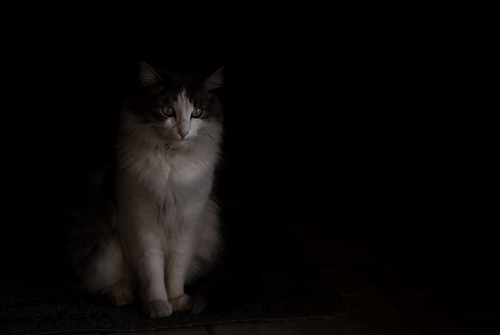
I was about to take a minimal picture of a white wall but my cat had other ideas and stuck it´s head in the frame so I ended up with a out of frame, minimal cat portrait :)
HEADS UP !
Steel Giraffes Jungle
730 meters and still growing...
Country Road - Summer (Image 2)
It was such a good timing during our visit since it fell on the time the Lotus lantern Festival also took place! Here you can see these colorful lanterns hanging around the Yeondeung Buddhist Temple!
---- .... ---- ....
Buddha's Birthday (simplified Chinese: 佛诞; traditional Chinese: 佛誕; pinyin: fó dàn; Cantonese: fātdáan), the birthday of the Prince Siddhartha Gautama traditionally celebrated in East Asia on the eighth day of the fourth month in the Chinese lunar calendar, is an official holiday in Hong Kong, Macau, and South Korea. The date varies from year to year in the Western (Gregorian) calendar:
The birth of the Buddha is often celebrated by Buddhists in India for an entire month in the Buddhist calendar. The actual day is called Buddha Poornima (or Buddha Purnima), also traditionally known as Vaishakh Poornima. Although the day marks not just the birth of Shakyamuni Gautam Buddha, but also the day of Enlightenment, and Mahaparinirvana. But as a gentle effect of West, the event of Birth is given paramount importance. The event is celebrated by gentle and serene fervour, keeping in mind the very nature of Buddhism. People, especially women, go to common Viharas to observe a rather longer-than-usual, full-length Buddhist sutra, as something like a service. The usual dress is pure white. Non-vegetarian food is normally avoided. Kheer, a sweet rice porridge is commonly served to recall the story of Sujata, a maiden who, in Gautama Buddha's life, offered the Buddha a bowl of milk porridge after he had given up the path of asceticism following six years of extreme austerity. This event was one major link in his enlightenment. It is said that the Buddha originally followed the way of asceticism to attain enlightenment sooner, as was thought by many at that time. He sat for a prolonged time with inadequate food and water, which caused his body to shrivel so as to be indistinguishable from the bark of the tree that he was sitting under. Seeing the weak Siddhartha Gautama, a girl named Sujata placed a bowl of milk in front of him as an offering. Realizing that without food one can do nothing, the Buddha refrained from harming his own body. Japan In Japan, Buddha's Birthday is also celebrated according to the Buddhist calendar but is not a national holiday. On this day, all temples do celebratory events/festivals called Kanbutsu-e (Japanese: 灌仏会), 降誕会 (Goutan-e), 仏生会 (Busshou-e), 浴仏会 (Yokubutsu-e), 龍華会 (Ryuge-e), 花会式 (Hana-eshiki) or 花祭(Hana-matsuri, meaning 'Flower Festival'). The first event was held at Asuka-dera in 606. Japanese people pour ama-cha (a beverage prepared from a variety of hydrangea) on small Buddha statues decorated with flowers, as if they bathe a newborn baby. Korea In Korea the birthday of Buddha is celebrated according to the Lunisolar calendar. This day is called 석가탄신일 (Seokga tansinil), meaning "the day of Buddha's birthday" or 부처님 오신 날 (Bucheonim osin nal) meaning "the day when Buddha arrived". Lotus lanterns cover the entire temple throughout the month which are often flooded down the street. On the day of Buddha's birth, many temples provide free meals and tea to all visitors. The breakfast and lunch provided are often sanchae bibimbap. Sri Lanka This is one of the major festivals in Sri Lanka. It is celebrated on the first full moon day of the month of May[citation needed]. People engage in religious observances and decorate houses and streets with candles and specially made lanterns. Other Countries Some places have a public holiday one week later, on the fifteenth day of the fourth month in the Chinese Lunar Calendar, to coincide with the full moon. For instance, Visakha Puja inThailand or Lễ Phật đản in Vietnam was such a holiday on May 12 in 2006. Other countries including Singapore and Malaysia also celebrate Vesak Day on the fifteenth day of the fourth month in the Chinese Lunar Calendar, a public holiday in these two countries. http://en.wikipedia.org/wiki/Buddha's_Birthday
THE LOTUS LANTERN FESTIVAL!

"Detroit Industry" - Detroit Institute of Arts ( Diego Rivera ) - View 1
History: Created by Artist Diego María de la Concepción Juan Nepomuceno Estanislao de la Rivera y Barrientos Acosta y Rodríguez, this Diego Rivera mural is on the facade of one of the houses that is considered to be a treasure of Mexican contemporary history. The mural now belongs to Mrs. Dolores Olmedo and was created in 1956, made with colored mosaics, stones and seashells. Regarded as one of the most important cultural works of art in Acapulco, the mural was one of the last works that the artist created before his death. In it are featured the Serpiente Emplumada Quetzalcóatl (Feathered Snake of Quetzalcoatl), a sphinx and an Aztec god.
http://en.wikipedia.org/wiki/Diego_Rivera
Mural Diego Rivera in Acapulco, Mexico
"A rock pile ceases to be a rock pile the moment a single man contemplates it, bearing within him the image of a cathedral."
-Antoine de Saint-Exupery
---
"I paint objects as I think them, not as I see them."
-Pablo Picasso
---
"Imagination and fiction make up more than three quarters of our real life."
-Simone Weil
IMAGINATION IN RED

JAZZ 9 OMETEOTL UNDER LINES AT SECOND LIFE - SECOND ATENTION

Scheveningen is one of the eight districts of The Hague; with many cute seaside restaurants, long beaches, kite surfers, a pier (with casino) and lots of art scattered everywhere. This one here by Igor Mitoraj is looking out to the North Sea. For some info about art exhibits in Scheveningen, go to beeldenaanzee.nl.
- - - - - - - -
Igor Mitoraj (born 1944) is a Polish artist born in Oederan, Germany.
He studied painting at the Kraków School of Art and at the Kraków Academy of Art under Tadeusz Kantor. After graduating, he had several joint exhibitions, and held is first solo exhibition in 1967 at the Krzysztofory Gallery in Poland. In 1968, he moved to Paris to continue his studies at the National School of Art.
Shortly afterwards, he became fascinated by Latin American art and culture, spending a year painting and travelling around Mexico. The experience led him to take up sculpture.
He returned to Paris in 1974 and two years later he held another major solo exhibition at the Gallery La Hune, including some sculptural work. The success of the show persuaded him that he was first and foremost a sculptor.
Having previously worked with terracotta and bronze, a trip to Carrara, Italy, in 1979 turned him to using marble as his primary medium and in 1983 he set up a studio in Pietrasanta. In 2006, he created the new bronze doors and a statue of John the Baptist for the basilica of Santa Maria degli Angeli in Rome. However report hot controversy as a result of installation (April 5 2008) of his work in Piazza Trento in Tivoli, opposite the church of St. Maria Maggiore and the Villa d'Este. The location of the fact has put at risk the celebration of the rite dell'Inchinata. The work was moved on August 11, in this way was made possible the sacred ceremony. The statue was then called in situ on August 20, 2008. The citizens of Tivoli, which already signed a petition People (4800 signatures, the source Il Messaggero) against the installation of sculpture, even aesthetically and historically totally alien to the site, hope that in future the removal can be definitive.
Testa Addormentata located in Canada Square, Canary Wharf, London

LIGHT OF THE MOON BY IGOR MITORAJ, BEELDEN AAN ZEE - SCHEVENINGEN, DEN HAAG, NETHERLANDS
Today on the radio in the United States reported that no deaths have happened like in Mexico ... because early detection and proper treatment are essential. Reportedly died in Mexico because so many people even had the technology to diagnose early. Besides the high cost of medicines.
-- ---------- ---------- ---------- ---------- --
Flu spreads around the world in seasonal epidemics, resulting in the deaths of hundreds of thousands annually — millions in pandemic years. Three influenza pandemics occurred in the 20th century and killed tens of millions of people, with each of these pandemics being caused by the appearance of a new strain of the virus in humans. Often, these new strains result from the spread of an existing flu virus to humans from other animal species. An avian strain named H5N1 had until recently posed the greatest risk for a new influenza pandemic since it first killed humans in Asia in the 1990s. Although H5N1 virus has not mutated to a form that spreads easily between people , in April 2009 a novel H1N1 flu strain that combined genes from human, pig, and bird flu, initially dubbed the "swine flu," emerged in Mexico, the United States, and several other nations. By late April, the H1N1 swine flu was suspected of having killed over 150 in Mexico, and prompted Mexico and U.S. travel advisories.
http://en.wikipedia.org/wiki/Influenza
LA POBREZA EN LOS TIEMPOS DE LA INFLUENZA - POVERTY IN THE TIMES OF INFLUENZA

EL TURISMO EN LOS TIEMPOS DE LA INFLUENZA / TOURISM IN THE TIMES OF INFLUENZA
“Man is a microcosm, or a little world, because he is an extract from all the stars and planets of the whole firmament, from the earth and the elements; and so he is their quintessence”
- Philipus Aureolus Paracelsus
MICROCOSM - ミクロコスモス
Or does the tree of life dream Gaia?
GAIA DREAMING THE TREE OF LIFE

It is native to humid evergreen forests in the American tropics. Range extends from extreme south - eastern Mexico to Amazoniain Peru and Brazil, in lowlands up to 500 m (1,640 ft) (at least formerly) up to 1,000 m (3,281 ft). It has been widely extirpated by habitat destruction and capture for the pet trade. Formerly it ranged north to southern Tamaulipas. It can still be found on the island of Coiba. It is also the Honduran national bird.
It is about 81 to 96 cm (32 to 36 inches) long, of which more than half is the pointed, graduated tail typical of all macaws. The average weight is about a kilogram (2 to 2.5 pounds). The plumage is mostly scarlet, but the rump and tail-covert feathers are light blue, the greater upperwing coverts are yellow, the upper sides of the flight feathers of the wings are dark blue as are the ends of the tail feathers, and the undersides of the wing and tail flight feathers are dark red with metallic gold iridescence. Some individuals may have green on the wings near the yellow band. Three subspecies present varying widths in their yellow wing band. There is bare white skin around the eye and from there to the bill. Tiny white feathers are contained on the face patch. The upper mandible is mostly pale horn in color and the lower is black. Sexes are alike; the only difference between ages is that young birds have dark eyes, and adults have light yellow eyes.
Scarlet Macaws make loud, low-pitched, throaty squawks, squeaks and screams designed to carry many miles.
Two Scarlet Macaws at the Henry Doorly Zoo in Omaha, Nebraska.
Before the Scarlet Macaw's decline in population, its distribution included much of Costa Rica. However, by the 1960s Scarlet Macaws had been decreasing in numbers due to a combination of factors, particularly hunting, poaching, and the destruction of habitat through deforestation. Further, the spraying of pesticides by companies cultivating and selling bananas for export played a significant role in decreasing Scarlet Macaw populations.
The combined factors stressed the population of Scarlet Macaws in Costa Rica, where they had previously occupied approximately 42,500 km² of the country's total national territory of 51,100 km², leaving viable populations in the early 1990s isolated to only two regions on the Pacific Coast of Costa Rica; the Carara Biological Reserve and Peninsula de Osa. By 1993 surveys had shown Scarlet macaws occupied only 20% (9,100 km²) of their historic range in Costa Rica.
SCARLET MACAW